The Garden That Changed Me” — A Personal Journey
— By Mr. Sam George, Manager, Kallinecherra Tea Estate
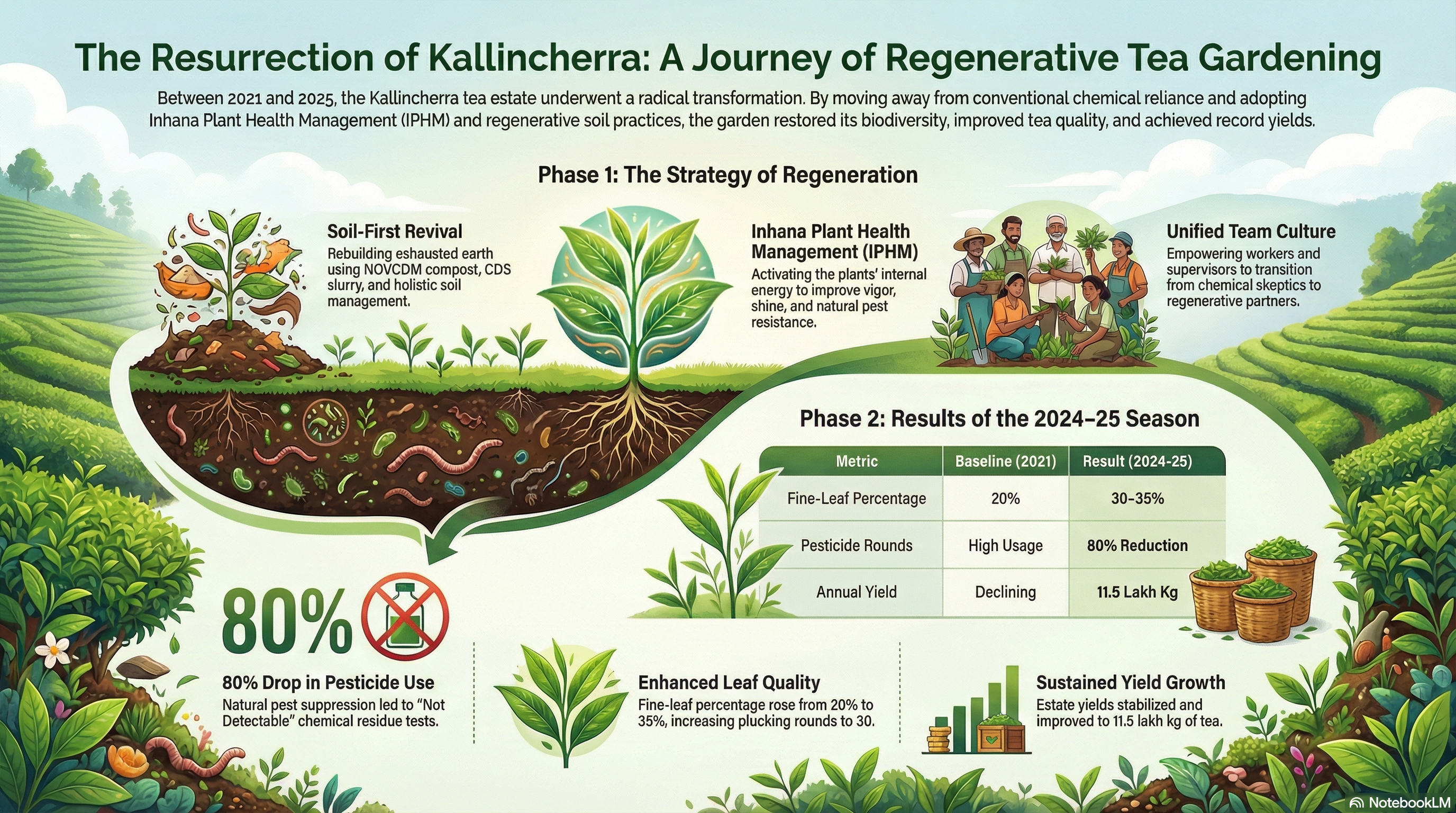
When I first arrived at Kallinecherra in early 2021, the garden felt like a beautiful old manuscript—once glorious, now weathered, its pages frayed by time. The slopes looked tired, the bushes lacked their former shine, and the soil… the soil felt like it had forgotten how to breathe. Standing at the entrance for the first time, I felt both excitement and a heavy sense of responsibility. This was not just a job. This was a calling, a test of who I was and what I believed in.
There were days I wondered whether I had made the right decision. The yields were declining, weeds were rampant, pest pressure unpredictable, and the soil had lost its vitality. Workers were demotivated; the garden seemed to carry the weight of years of struggle. Some mornings, walking through the bushes, I felt as if the estate was whispering its sadness.
But something inside me refused to accept defeat. I believed that every garden, like every human being, has a heart—a pulse waiting to be revived.
And then came the turning point.
A conversation.
A spark.
A new vision.
It came through the guidance of Dr. P. Das Biswas , whose presence was like light entering a dim room. When he spoke about soil as a living organism, plants as intelligent beings, and nature as a partner—not a battlefield—it felt as if someone had finally decoded what the garden had been trying to tell us. His words weren't technical instructions; they were poetry woven with science, philosophy merged with physiology.
Under his mentorship, we began our journey of regeneration.
The Struggle Before the Bloom
The first year was not romantic. It was hard work—backbreaking, humbling, sometimes discouraging.Workers weren't sure why we were suddenly applying compost instead of chemicals…
Supervisors doubted whether yields would fall…
Even I had moments of quiet fear.
But transformation demands patience. Renewal demands faith.
We started with the soil—NOVCOM compost, CDS slurry, weed cleaning, soil management. At first it all felt too gentle… too patient… almost unbelievable for a soil that had suffered years of exhaustion. But I kept faith. Every week, as I scooped a handful of earth, I could sense a quiet change happening beneath the surface—softness returning, warmth building, a faint breath of life awakening.
And then… the true magic began.
It came with the Inhana Plant Health Management Solution .
The first time we sprayed it on the tea bushes, the workers joked, “Sahab, ei pani-te ki jadu achhe?”
At that moment, even I didn't know how right they were.
Within weeks, I watched the bushes respond as if someone had whispered hope into their veins. The leaves stood up straighter—firm, turgid, glowing with a kind of inner energy that no chemical had ever produced. The shoots pushed out faster, with vigor and shine. Pest pressure dropped as if nature itself had decided to protect the garden. The plants looked confident —a word I had never used for bushes before.
That was the turning point.
IPHM didn't just improve plant health; it awakened the estate.
The workers saw it, the supervisors felt it, and I… I lived it every morning as I walked the lines. I realized that this was the missing piece all these years—something that went beyond fertilizer and pesticide. Something that worked with nature, not against it. Something that created harmony inside the plant system itself.
With every spray, the estate felt like it was breathing deeper… growing stronger… reclaiming the glory it once had.
.
The Garden Began to Respond
The bushes looked greener, the flush became uniform, pests stopped attacking as aggressively, and fine-leaf percentage began to rise. Workers who once doubted the system started coming to me with smiles, saying:“Saab, jor aashche… gaach ta phire uthche.”
( “Sir, there is new energy… the garden is coming back.” )
Those words… I will never forget them.
We became a team—not just staff and labour, but a united family who believed in the miracle we were creating. The field became our classroom. Every day, we learned, unlearned, experimented, and acted with purpose.
Moments that Made Me Believe
I still remember the first time I saw ladybird beetles return in large numbers. For many, it was just a small insect. For me, it was a sign—nature was trusting us again.I remember the first cup of made tea after our initial season of regeneration. The aroma was different, deeper… almost nostalgic. As if the estate had rediscovered its soul and placed it gently into that cup.
And most of all, I remember the pride in the workers' eyes when the first positive results came. They felt ownership. They felt dignity. They felt hope.
Success Was Not Sudden — It Was Earned
By 2024–25, the data told a story that our hearts already knew:• Fine-leaf % rose from 20% to 30–35%
• Plucking rounds increased from 20 to nearly 30
• Pesticide rounds dropped by almost 80%
• Soil organic carbon started rising
• Biodiversity returned
• Yields steadied, then improved to 11.5 lakh kg
• Residue tests came “Not Detectable”
These weren't just numbers.
They were proof of what unity, science, and love for the land can achieve.
What Kallinecherra Taught Me
Some people say managing a tea estate is about discipline, data, and planning. Yes, it is. But Kallinecherra taught me something deeper:• You cannot manage a garden unless you love it.
• You cannot revive soil unless you respect it.
• You cannot lead people unless you walk with them.
• And you cannot create change unless you believe in it fully.
This estate made me a better manager, a better learner, and perhaps even a better human being.
Our Journey Ahead
Today, when I walk through Kallinecherra at dawn and see the sunlight touching the vibrant green carpet of bushes, I feel a quiet pride. Not personal pride—but collective pride. Pride of workers who stood with me. Pride of a management who supported every decision. Pride of Dr. P. Das Biswas, who guided us like a lighthouse in a storm. Pride of a garden that refused to give up.Kallinecherra is not just producing tea anymore.
It is creating a legacy.
A regenerative, climate-positive, nature-honouring legacy.
And I, Sam George, am grateful—deeply grateful—
to have been chosen by this garden,
to have grown with it,
failed with it,
learned with it,
and finally…
to have rebuilt it with love.
This is not just my journey.
This is our journey — the journey of Kallinecherra.